Background
What does the Holocaust mean for us?
What does it mean to be a Holocaust survivor?
Why do we speak out?
The Holocaust
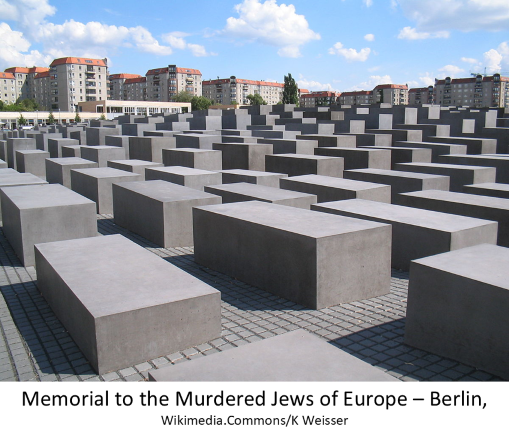
The Holocaust is the name given to the genocide of the Jews of Europe by Nazi Germany and its collaborators; it is also called the Shoah, the Hebrew word for catastrophe or annihilation. It is estimated that around 6 million Jewish people were murdered, approximately two thirds of the population; they died from violence as well as through sickness, overwork, deprivation and starvation. The systematic persecution of Jewish people began when the National Socialists (Nazis) took power in Germany in 1933 and reached its climax in the period 1941-1945 during the Second World War with the establishment of purpose-built extermination camps (principally Auschwitz-Birkenau and Treblinka) and the widespread deployment of death squads (Einsatzgruppen). It is recognised as one of the most abhorrent events in human history.
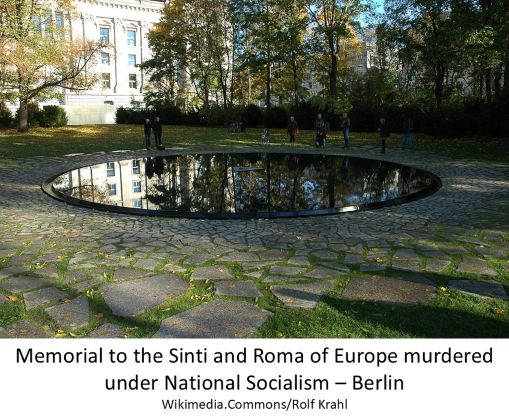
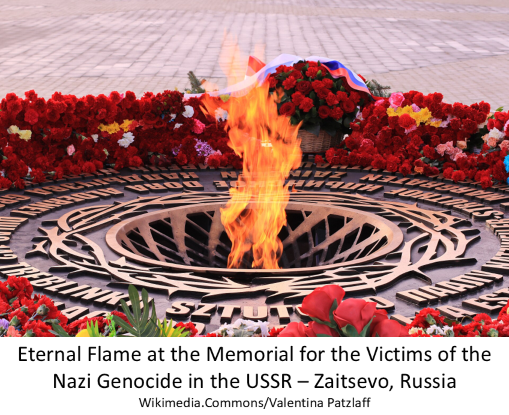
However, the Holocaust of the Jews of Europe was not the only genocide perpetrated by Nazi Germany and its allies. An estimated 500,000 Sinti and Roma were murdered (some estimates say up to a million), around half the European population, a genocide sometimes given the name Porajmos, a Romany word for devouring. The murders of Slavic people in Poland and the Soviet Union as part of Germany’s quest for Lebensraum under the Generalplan Ost led to around 11 million deaths, separate from the millions who died in combat. These genocides used the same methods and locations as the Holocaust: Romani people were herded into the Warsaw Ghetto and murdered in Auschwitz, the first victims of Zyklon B poison gas in the Auschwitz gas chambers were Soviet prisoners of war.
In addition, Nazi Germany perpetrated the persecution and murder of a range of other groups of people, even though these may not be classified as genocides. The categories included political opponents (mainly communists and socialists), disabled people, homosexual men, religious groups (notably Jehovah’s Witnesses), so-called ‘antisocial persons’ (such as beggars and the homeless) and foreign forced labourers.
Nor were these Nazi genocides the only ones that Germany perpetrated in its recent history. During its imperial colonial era, Germany murdered tens of thousands of Herero and Nama in present-day Namibia as well as hundreds of thousands of native people in East Africa.
Elsewhere in the world there have been numerous other genocides in modern times. These include: the Turkish genocide of the Armenians (in which Germany also participated), the Libyan genocide by the Italian colonial authorities, the Holodomor famine in Ukraine under Stalin in the USSR, the Cambodian genocide by the Khmer Rouge, the Hutu genocide of the Tutsis in Rwanda, and many more.
Reference to other genocides and mass killings is not intended to downplay, minimise or understate the horrors of the Holocaust, let alone to deny it or to disclaim any of its thoroughly documented features. On the contrary, we ourselves or our forebears were among the victims of the Holocaust and we recognise it as one of the worst atrocities ever perpetrated.
What we do not accept is that the Holocaust should be incomparable to other genocides that have happened in the past and, more importantly, to those that are happening now and in the future. Moreover, we totally repudiate the notion that the Holocaust can be used to justify the perpetration of illegal acts of violence, whether by its victims, their descendants or those claiming to act in their name. In particular, we absolutely reject the use of the history of the Holocaust to legitimise the perpetration of the genocide which Israel has been and is still perpetrating against the indigenous people of Palestine.
Survivors
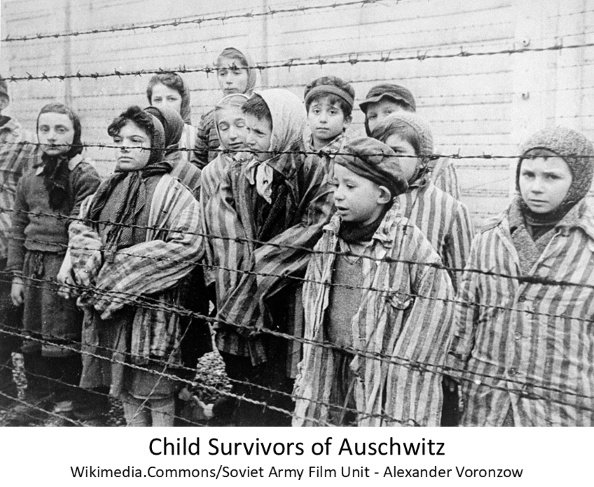
There is no universally accepted single definition of a Holocaust survivor, but the term is widely used to include any Jewish persons in the territories controlled by Nazi Germany or its allies and who, by whatever means, did not meet their death at the hands of the perpetrators, as millions did. It may also include those who fled in anticipation before the Nazis and their allies took over the territories where they lived.
Surviving the Holocaust took many forms. At the most extreme level, there were victims of the Nazi concentration camps and even extermination camps, who were still alive at the end of the war when they were liberated, or who had managed to escape and remain uncaptured. Survivors were also liberated or freed themselves from death marches, ghettos and forced labour sites. They had endured almost unimaginable mistreatment and hardship.
Others survived by hiding, by adopting false identities or by joining resistance movements such as the partisans in Poland or the Soviet Union. They too suffered the constant fear of discovery and capture.
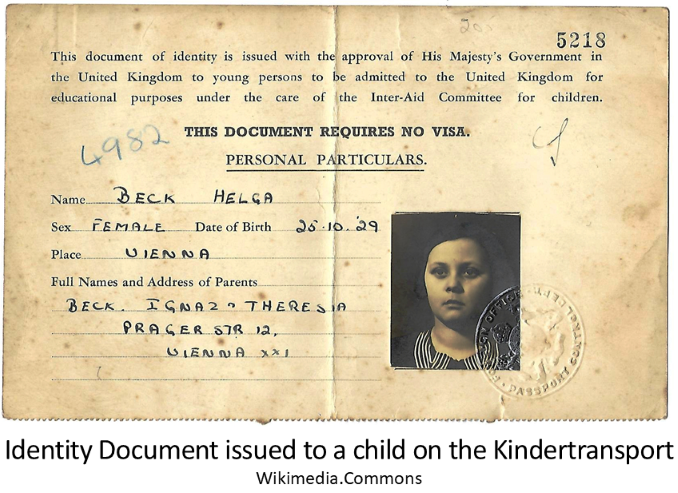
Some were able to flee from their homes and find refuge in other countries. They did not suffer as those in camps, ghettos, death marches and forced labour suffered, but they lost their homes, possessions, livelihood, culture, language, family and friends. If they had stayed, they would probably have been murdered; they survived because they were able to flee. They did not always receive a welcome in the countries to which they fled, including in Britain and the United States. The famous Kindertransport scheme, by which thousands of children were brought to Britain, was not a universal model; many were turned away and others were interned in camps as so-called ‘enemy aliens’. A similar and sometimes worse reception faced those who fled to other countries.
We and our forebears fall into many of these different categories. Whatever the form of survival may have been, it has left its mark on our families and on us. For this reason, we stand with all those who suffer under oppression, violence and war and with those who have had to flee for their lives.
Speaking out
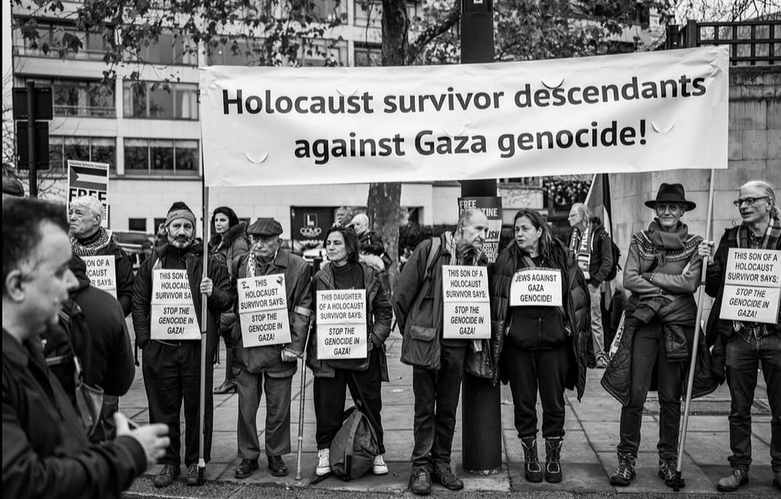
We feel a particular need to speak out about the oppression of the Palestinian people. We are very conscious of the violence and persecution being inflicted on people in many parts of the world. However, the subjugation, apartheid, illegal occupation, expulsion, incarceration, torture and genocide that Israel has perpetrated on the people of Palestine has frequently been defended, excused or justified with reference to the suffering of Jewish people in the Holocaust. As survivors and descendants of survivors of the Holocaust, we wholly reject such a false rationale: one atrocity does not justify another.
Furthermore, we also reject the notion that opposing the actions of the government, the armed forces and, sadly, too many of the people of Israel in any way dishonours the memory of those who died and suffered in the Holocaust. On the contrary, we consider it our obligation to speak out for them and for all victims of oppression.
At the same time, we do not claim that our voices are special. We certainly do not consider that they are even as valid as the voices of Palestinians, who are the principal victims of the crimes being perpetrated in their homeland. However, in a world where the evils of the Holocaust have been used to avert criticism from the evils being committed in Palestine, we acknowledge that our history and that of our families places a duty upon us to speak out.
We adhere to the principle of universality for the maintenance of freedom, the enforcement of justice and the opposition to oppression.
‘Never again!’ means ‘Never again for everyone!’