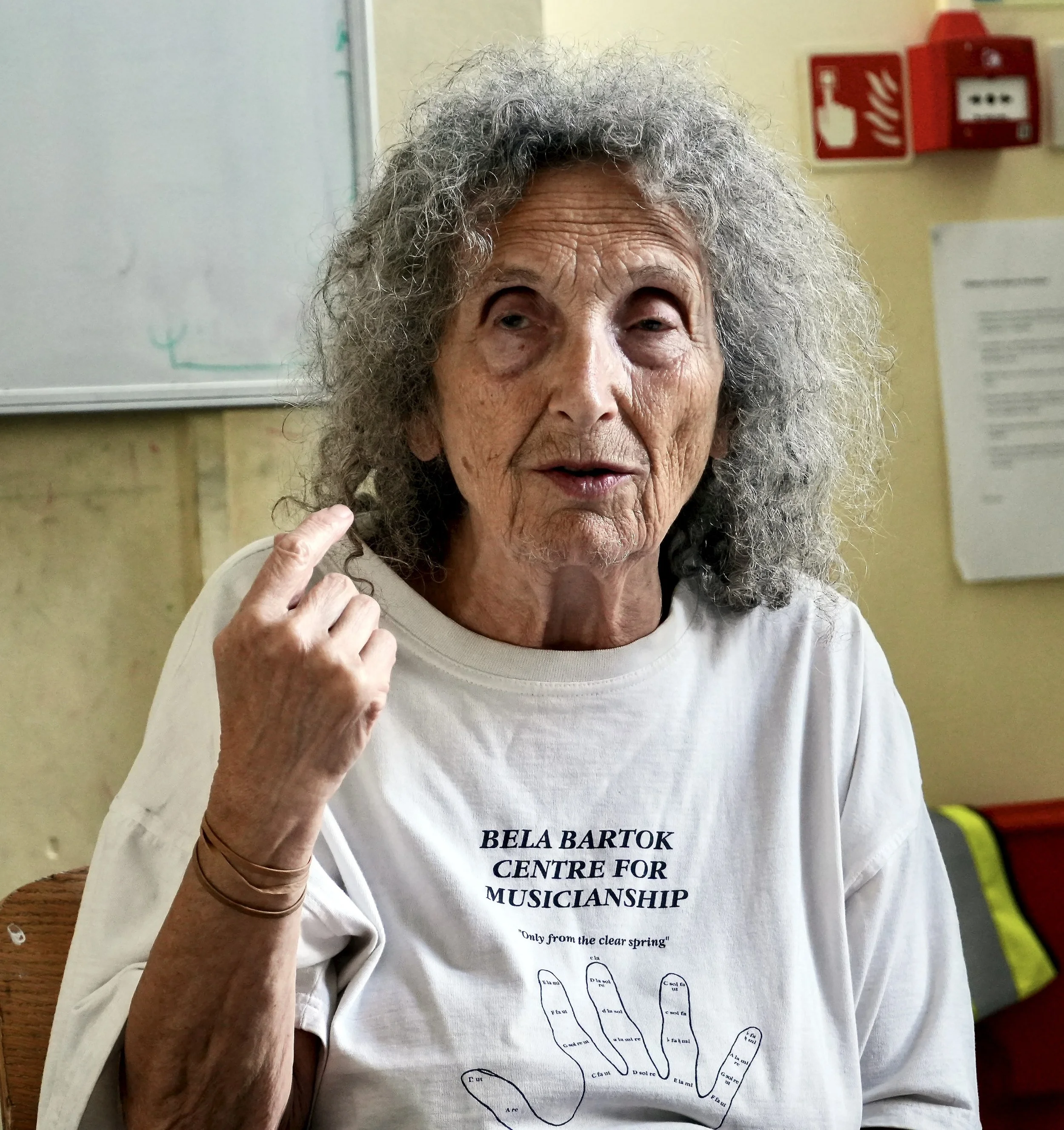
Agnes Kory’s Story
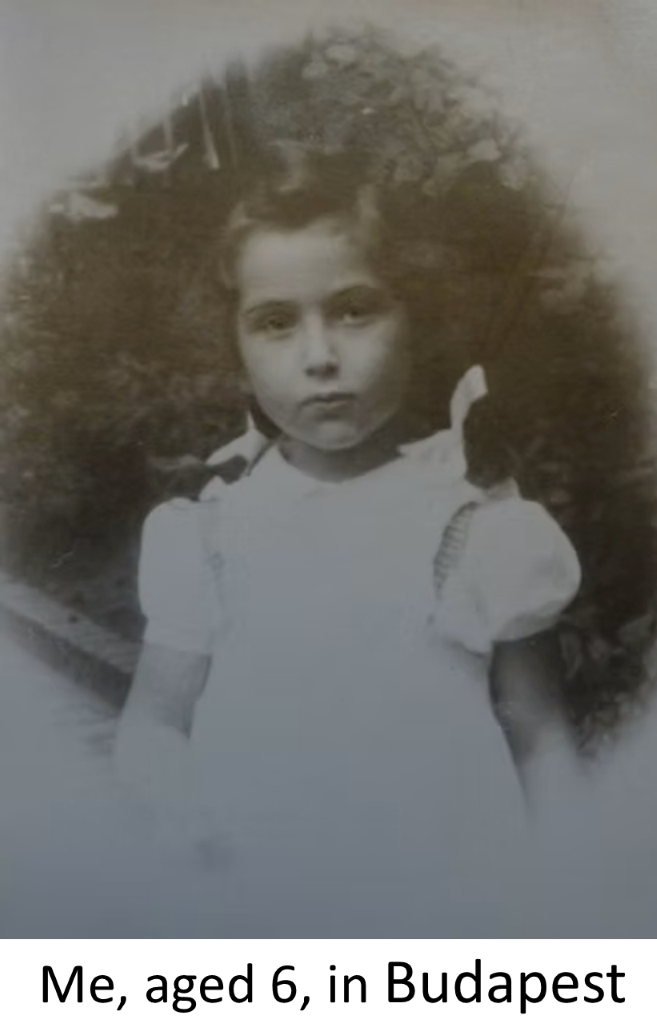
I was born in Budapest (Hungary) in December 1944, at the peak of the murderous Arrow Cross Party's reign. The Arrow Cross Party was a far-right Hungarian ultranationalist fascist party - led by Ferenc Szálasi - which formed a government in Hungary from October 1944 to April 1945 that collaborated with Nazi Germany.
The Germans had invaded Hungary in March 1944. During the period of May - July 1944, Hungarian gendarmerie officials - under the guidance of German SS officials - deported around 440,000 Jews from Hungary. Most were deported to Auschwitz-Birkenau, where, upon arrival and after selection, SS functionaries killed the majority of them in gas chambers.
Thousands were also sent to the border with Austria to be deployed at digging fortification trenches. By the end of July 1944, the only Jewish community left in Hungary was that of Budapest, the capital.
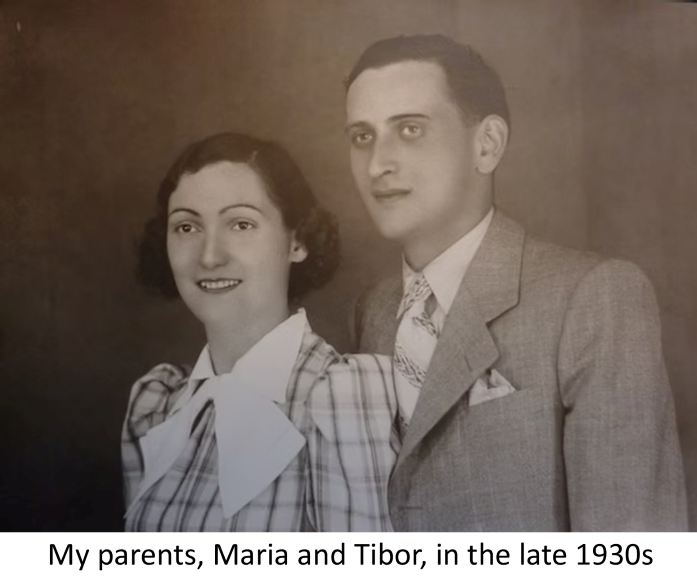
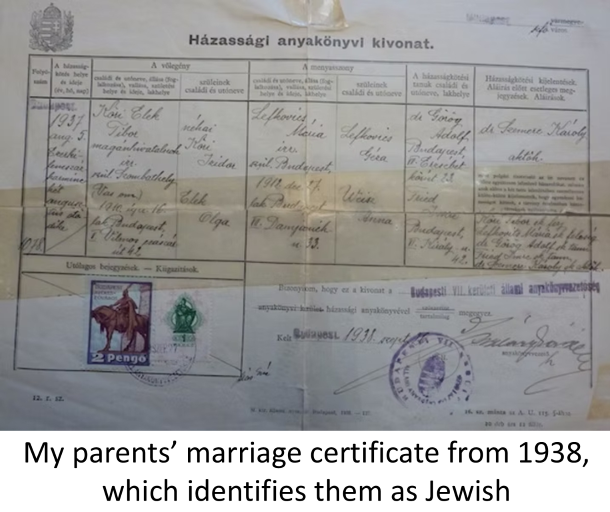
In the autumn of 1944, my father Tibor, a low-level administrator in the building industry, was taken to Mauthausen concentration camp (from where he returned in August 1945) and my pregnant mother Maria, a piano teacher, went into hiding with false papers. According to these papers she was Protestant and unmarried: the child she carried was illegitimate, that is outside marriage. It is of note that the papers belonged to the wife of the janitor in the Budapest block of flats where my mother and father lived for some eight years before October 1944. This lady, Julia Sarkany, was married and gave her papers from her previous unmarried life to my mother. She might not have been wealthy or well-educated, but she took the risk to save my mother.
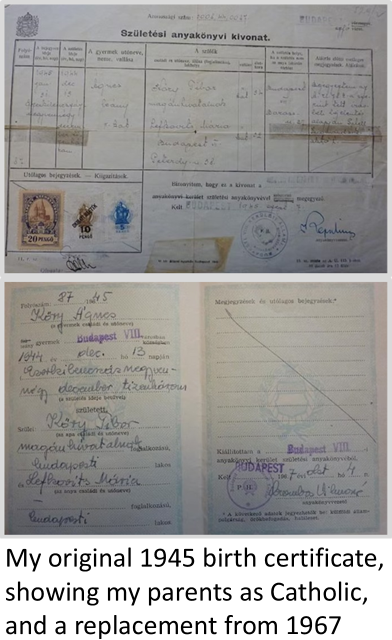
As a result, I was born and even baptised as Agnes Sarkany. With her false papers my mother worked as a hospital cleaner to ensure a safe assisted birth for me: the hospital insisted on baptising all newborn babies.
My mother was treated very badly by other hospital workers: not because she was Jewish (which was not known to anybody in the hospital), but because she was unmarried with a bastard child. The cruelty was extended to me too: it is astonishing that I survived those months and the aftermath.
In January 1945 the Red Army liberated the Budapest ghetto where some 70,000 (seventy-thousand) Budapest Jews were crammed into unbearable conditions waiting for death; one Russian soldier liberated my mother and me. When my mother saw a Russian soldier standing next to where she was sleeping in the basement of the hospital, she knew that both of us would survive...and we did.
On my 13th birthday my mother presented me with her memoir. It was written in March 1945 with the cover page stating: "To my darling little Agnes, so that you fight that such time I am telling you about should never be repeated." Copies of my mother's beautiful Hungarian memoir are placed in various museums such as Yad Vashem, Wiener Holocaust Library and Vancouver Jewish Museum.
Inspired by my mother's memoir, I started my Holocaust research at age 15 and submitted my first substantial piece on Holocaust and Hungarian Jewish musicians at age 18. This piece, specifically about the murdered composer Sandor Kuti, is still held at the Institute of Musicology in Budapest.
After the war my mother returned to piano teaching and was also among the first Kodaly musicianship teachers in Budapest.
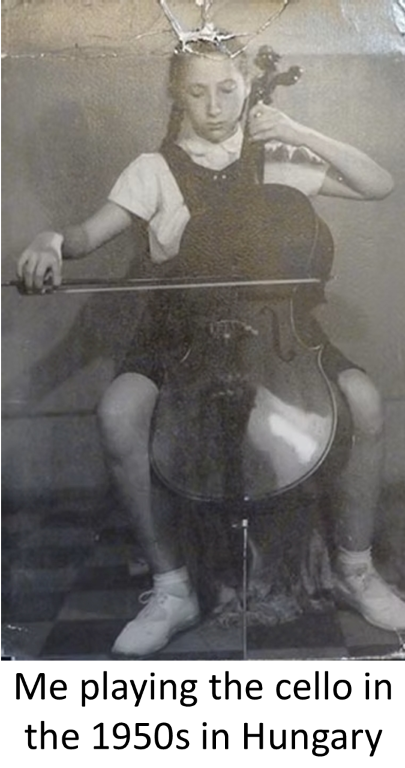
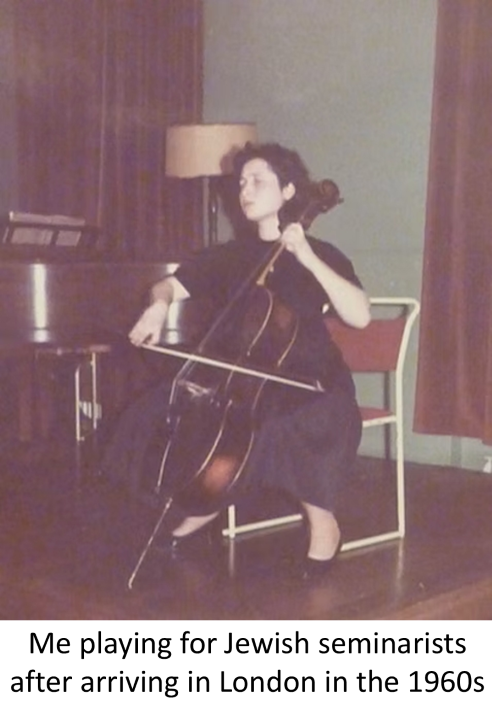
Having been rejected from entering studies at the Music Academy in Budapest, in October 1965 I came to England with a two-week tourist visa and stayed ever since (and became British in the process). My parents stayed in Budapest, but I came to England because it appeared to be the centre of music world in Europe. After studying at the Royal Academy of Music (DipRAM obtained in 1969), I worked as a professional cellist (Royal Ballet, English National Opera) and as a volunteer music critic. From 1989 I embarked on academic studies, gaining the degrees of BMus, MMus, MPhil and PhD. I am also the founder director of the Bela Bartok Centre for Musicianship which I set up in 1992.
By default, I was a Zionist almost all my life. However, owing to the brutal treatment of Palestinians by the Israelis, this changed recently. I am no longer a Zionist who is critical of some aspects of Israeli policies, by now I am anti-Zionist. As a Jewish Holocaust survivor, I cannot tolerate the genocide against Palestinians. My mother's memoir of March 1945 urged me to fight so that times like the Holocaust should never be repeated again. For me this fight includes the plight of the Palestinians.